About Invisibility, Propaganda, and Assumptions of Incompetence
Reading time: about 7 minutes
Published
Originally published in dev.to

This is a submission for the 2026 WeCoded Challenge: Echoes of Experience
It’s the time of the year when I feel most conflicted. Tomorrow’s International Women’s Day, and as I’ve witnessed in the past years, it’s usually the time when men start asking about when International Men’s Day is, and telling how equality has gone too far. Of course, not all men, but usually a man.
In Finland, we also have Minna Canth’s day and the day of equality on the 19th of March, and in the days between these dates, all kinds of weird anti-equality stuff and trolls pop up. As someone who cares deeply about equality and human rights, this time is a bit stressful.
By the way, Minna Canth was a Finnish writer, businesswoman, and social influencer, best known for her work on women’s rights. If you’re interested in knowing more about her, here’s a link to Wikipedia: Minna Canth.
Anyway, I also enjoy this time of year a lot. Especially Dev’s We Coded has a special place in my heart - reading posts from other people who are from underrepresented genders in tech, and seeing how the community comes together to defend those who get some nasty or uncalled-for comments to their posts.
This is my sixth time participating in We Coded, and over the years, I’ve shared my experiences as a nonbinary woman in tech. I’ve also shared some tips for allies, but last year, I decided to just share my experiences because so many people keep telling me there are no problems and that tech is equal for all, so I’m using my efforts to show otherwise. And I’m going to continue it this year as well, with a couple of tips included.
Naturally, these examples are not everything I’ve witnessed and experienced since March 2025, but some selected examples. Let’s start with some invisibleness.
Non-Binary Woman, an Invisible Creature
This has been the first year I’ve fully embraced myself as a non-binary person. I’m still figuring out the details, so I’ve been introducing myself as a non-binary woman because I still feel a connection to womanhood. I’ve lived as a woman for most of my life, but at the same time, deep down, I’ve known that I’m not a woman. Or, just a woman.
Anyway, one of the things I’ve started doing is referring to myself with “they” pronoun. Generally, I go by they/she, because I’ve decided not to use too much energy correcting people, so “she” is okay for me for now. But when I refer to myself, like in a bio or something that requires third person, I use “they”.
I was filling out a CV for a freelancer agency last spring. The person from the agency asked me to fill out the CV details, and they would edit it to make it more selling. I was ok with that. I’m not the best at coming up with hype words to sell my experience.
I wrote my bio using “they”. A bit later, I wanted to check something in the edited CV, so I opened the file and noticed the bio had been updated. Yes, there were some sentences that were better to sell my experience. But they had also changed the “they” pronouns to “she”.
I felt so freaking invisible.
I mean, it’s one thing when someone makes assumptions about me. I can understand that. But editing my own words, that hurts. And yes, they probably didn’t mean it. Heck, they probably didn’t even notice what they were doing.
So, a tip: Respect the pronouns someone asks you to use, and especially the pronouns they use of themselves. If someone writes their bio with some pronouns, they know what they’re doing. There is a reason for that.
What if Your Existence is Propaganda
Last year, I gave many talks about creative coding with Kotlin. The talks contained some live coding, and here’s a video of what I ended up building on stage:
Isn’t the ghost cute? If you’re interested in hearing the whole story, I’ve given this talk, for example, in Droidcon London (it was two weeks after the talk I’m sharing about): Creative Coding in Kotlin - talk.
Anyway, in the talk, the main idea behind the animation I created was that people are generally happier when they can be themselves. And that it’s partly based on my own story. I shared these things from the stage, as well.
At least two people who sat through it all and decided to give feedback via an anonymous channel, to which there was a QR code at the very end of the talk. So, I repeat, they sat through the entire talk, listening, and then gave some feedback. One was just numeric, but the other also gave some written feedback:
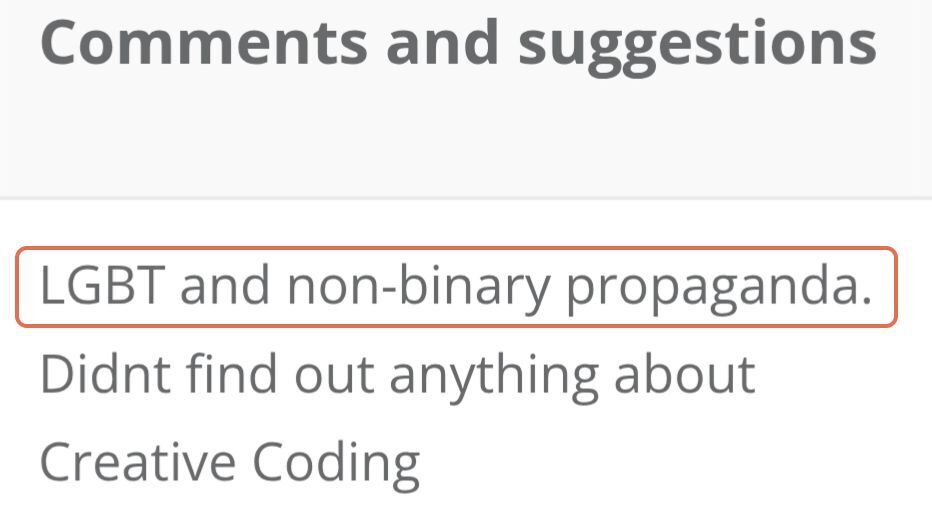
I saw this some time after the talk, still at the venue. I’m so glad I had other speakers around me who called the organizer in. They took it seriously as a Code of Conduct violation. Of course, this was an anonymous channel, so it wasn’t possible to reach out to the individual, but they addressed it in public.
Oh, by the way, the London talk went well. I gave a content warning (shouldn’t have to), and one person left the room, so no one got traumatized from my non-binary propaganda (/s).
Another tip: Anonymous feedback might sound like a great way to gather feedback for your speakers, but it really needs some moderation. After this incident, I would rather not take it, even if I risk missing some valuable feedback.
The Bad Ol’ Arguments
The year wouldn’t be complete without some ancient arguments. You know, those that the 1990´s want back. Like “I’ve never seen anyone discriminated”, coming from someone in a very privileged position.
To my surprise, my last year’s We Coded post didn't get many negative comments. This time, no one told me that the sole reason for my being in tech is that I’m just looking for a romantic partner, or that I’d get a promotion only if someone had “other motives” towards me. Or that I was showing my sexuality down everyone’s throats (when I was telling about my experiences, not touching the topic of sexuality, not one time).
However, there was one conversation in the comments where the commenter asked:
Should we lower our standards in the name of equality? Hire incompetent people because we need to check boxes?
And I just pointed out that it’s interesting that there’s an assumption of other genders being incompetent. Of course, there was another commenter telling me that no, that was not the case, and explaining to me “many employers” have hired less competent people in the name of equality, and when I asked if it was the person’s gut feeling, or if there was actual evidence of this happening, they never responded. So, I’m guessing it was the gut feeling.
I’m just so tired of this argument. Yes, before, even mediocre men got hired, but now that hiring standards are changing and competent people from other genders are being hired, it might feel ok to say they’re not competent because they threaten your place. And it might feel intimidating if you’re in the bracket that won’t get hired because there are other people who are more competent than you, who would not have been hired before because of the biases that exist. It might feel unfair, even. But you know, isn’t the idea that the most competent people get hired, regardless of their gender?
Wrapping Up
Okay, time to wrap up this year’s post before it turns into a novel. These were some experiences from a year as a non-binary woman in tech, who is sick and tired of the inequality we still face. The current world situation doesn’t help, and we need to be even more visible now that there’s a joint effort by people with far-right views, anti-gender movement, and those who use Christianity as an excuse, who are trying to erase us.
Of course, at the same time, it’s not always safe to be visible. And it’s important to take care of yourself and your loved ones. So, if you can, shine your light and be visible. I’m trying to do it for myself, and for those, who can’t.
If you’re someone from a gender minority in tech: I see you, and I celebrate you. You are enough, and you are skilled. When you’re doubting yourself, remember: You’ve come this far, and you’ve got this. And that it’s ok to rest as well, you don’t have to always fight.